Awarded US Patent
The Patented AC Joint Reconstruction Technique – Hope for Early AC Joint Repair
United States Patent – StruhlA United States patent is not a marketing claim. It is a determination by federal examiners, after years of examination, that an invention is genuinely novel and not obvious to others working in the same field. In April 2012 the United States Patent and Trademark Office granted Patent 8,162,997, Device for Treatment of Acromioclavicular Joint Dislocations, to Steven Struhl, MD.
The patent was later assigned to Smith and Nephew, one of the largest orthopedic device manufacturers in the world, which brought the design into commercial production. That second fact matters as much as the first. A patent establishes that an idea was novel. A global device company acquiring it establishes that the idea worked well enough to manufacture. Dr. Struhl is board certified in orthopedic surgery and separately in sports medicine, has practiced since 1991, and serves on the faculty of NYU School of Medicine.
Why the AC Joint Repair Technique Was Invented
Most surgical techniques are inherited. This one was invented, because the surgeon performing it kept watching the accepted method fail in the same way.
Dr. Struhl traces the invention to a failure pattern he could not stop seeing.
“I kept seeing the same failure. The repair looked perfect on the table and looked perfect at six weeks, and then somewhere around three months the clavicle would start to drift back up. It was not a technique problem. It was a hardware problem, and hardware problems have solutions.” – Steven Struhl, MD, Inventor, United States Patent 8,162,997
He began developing an alternative in 2002, filed the patent application in November 2007, and was granted it in April 2012, which is a decade of refinement between the first case and the federal grant.
How the Patented AC Joint Surgery Works
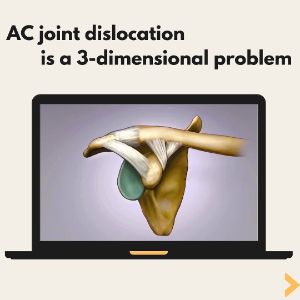
When an AC joint separation reaches grade three or higher, the coracoclavicular ligaments anchoring the collarbone to the shoulder blade tear completely. Without that anchor the clavicle rides upward, producing the visible bump, the loss of overhead strength, and the aching patients describe as living in the top of the shoulder.
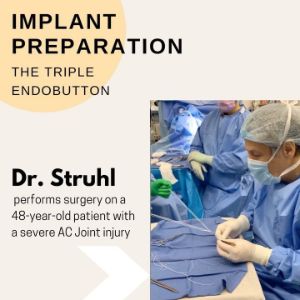
The patented construct restores the anchor using two small titanium buttons connected by a continuous, knotless suture loop.
- A Single Small Incision: the entire construct is placed through one short incision near the clavicle.
- No Knots To Fail: the continuous loop removes knot slippage and knot breakage as failure modes.
- Fixed Anatomic Length: the loop is manufactured to length rather than tensioned by hand at surgery.
- Biologic Healing Support: ligament transfer or repair encourages durable scar tissue to form.
The knot is the point. Conventional reconstructions rely on suture knots or adjustable loops tensioned by the surgeon during the procedure, and both introduce the same vulnerability, a mechanism that can loosen after the surgeon has closed. How the technique is performed covers the surgical detail step by step.
Common Concerns About AC Joint Separation Surgery
Most people who reach this page have already been told something discouraging, usually that a grade three should be treated without surgery and that the bump is cosmetic.
- The Bump Is Not Only Cosmetic: upward clavicle migration changes shoulder mechanics and overhead strength.
- Fixation Loss Is The Real Risk: many conventional repairs slowly lose position over the first year.
- Timing Affects Options: earlier reconstruction generally allows a more direct and durable repair.
- Chronic Injuries Remain Treatable: the majority of patients in the published study were chronic cases.
Dr. Struhl pushes back on the cosmetic framing directly, noting that “patients are told the bump is cosmetic, and for some people that is true. But if you cannot press overhead without aching, or you cannot carry a bag on that shoulder, that is not cosmetic. That is a joint that is not doing its job.” – Steven Struhl, MD
Published Outcomes of the Double Endobutton Technique
The technique is not supported by testimonials alone. Dr. Struhl published his own long term outcomes in The American Journal of Sports Medicine in 2015, coauthored with Theodore S. Wolfson, MD, covering thirty five patients treated between 2003 and 2012 for Rockwood type III or greater dislocation. Mean follow up was 5.2 years, and individual patients were followed as long as twelve years.
- Stability Maintained: the construct held in all but one patient over the full follow up period.
- Position Preserved: eighty seven percent held a coracoclavicular interval difference under two millimeters.
- Function Restored: mean Constant and ASES shoulder scores of 98 out of 100.
- Safety Profile: no infections, no fractures, and no perioperative complications reported.
Publishing in a peer reviewed journal means the methods and the numbers were examined by other orthopedic surgeons before release, and that anyone can read the paper and judge it. It is indexed in PubMed and available through the journal. Dr. Struhl’s full publication record is here.
Frequently Asked Questions About the Patented AC Joint Procedure
- United States Patent 8,162,997, titled Device for Treatment of Acromioclavicular Joint Dislocations, filed November 5, 2007 and granted April 24, 2012, with Steven Struhl, MD listed as the inventor. It was subsequently assigned to Smith and Nephew, Inc.
- Conventional reconstructions rely on suture knots or adjustable loops tensioned by the surgeon during the procedure, and both can loosen over time. The patented construct uses a continuous loop manufactured to a fixed length, so there is no knot to slip and no adjustment to lose.
- No. The design was assigned to Smith and Nephew and is commercially manufactured, so the device is available to surgeons. What the patent establishes is who developed it and that federal examiners judged the design genuinely novel.
- The reconstruction is performed through a single small incision near the clavicle rather than a large open exposure, which is why patients typically see a modest scar and a faster return to daily activity than older open techniques allowed.
- Yes. Twenty six of the thirty five patients in the published study had chronic dislocations rather than acute injuries, and results in that group were comparable, so an injury that is months or years old is still worth evaluating.
- Most patients wear a sling for roughly six weeks while the biologic healing takes hold, begin supervised motion shortly after, and return to unrestricted activity over the following months. Full recovery timelines are here.
Why This Matters When Choosing an AC Joint Surgeon
- Documented Invention: a granted federal patent rather than a proprietary sounding brand name.
- Industry Validation: the design was acquired by a major orthopedic device manufacturer.
- Peer Reviewed Evidence: published outcomes in a leading sports medicine journal.
- Two Decades Of Refinement: the technique has been developed continuously since 2002.
- High Case Volume: more than 200 acromioclavicular joint reconstructions performed.
Schedule an AC Joint Evaluation in New York City
An accurate grade is the first thing a separated shoulder needs, and it is the thing most commonly gotten wrong, because a standard film taken while the arm is supported can make a grade three look like a grade two. Dr. Struhl evaluates AC joint injuries at his Manhattan and White Plains offices and reviews outside imaging for patients traveling from elsewhere. Contact our practice at (212) 207-1990 in New York City or (914) 328-4111 in Westchester, and bring your existing X rays or MRI so the discussion can begin with what the images actually show.