Most people have never heard of the acromioclavicular joint until they injure it, and then it becomes the only joint they think about. It is small, it sits directly under the skin at the top of the shoulder, and it is the only bony connection between the arm and the rest of the skeleton.
Steven Struhl, MD studied engineering at the Massachusetts Institute of Technology before medical school, and the mechanical logic of this joint is a large part of why he ended up designing a device to repair it. He earned his medical degree at the University of California, San Francisco, is board certified in orthopedic surgery and separately in sports medicine, and holds United States Patent 8,162,997 for acromioclavicular reconstruction.
The Anatomy of the Acromioclavicular Joint
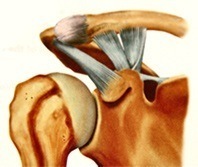
The joint is formed where the outer end of the clavicle meets the acromion, the bony shelf projecting forward from the top of the shoulder blade. A small fibrocartilage disc sits between the two surfaces, cushioning the contact.
- The Clavicle: the collarbone, connecting the arm to the sternum at its inner end.
- The Acromion: the highest point of the shoulder blade, forming the roof of the shoulder.
- The Articular Disc: a small cushion between the two bone surfaces that thins with age.
- The Joint Capsule: the sleeve of tissue enclosing the joint and holding fluid within it.
You can usually find it by tracing along your collarbone toward the shoulder until you reach a small step just before the shoulder rounds off. That step is the joint.
It is worth being clear that this is not the shoulder joint itself. The shoulder joint proper is the ball and socket where the arm bone meets the shoulder blade, and it sits below and inside the acromioclavicular joint. Different problems affect each of them, and conditions of the main shoulder joint are diagnosed and treated quite differently.
The Two Ligament Systems That Hold It Together
This is the part that determines everything about how the joint fails, and it is the reason separations are graded the way they are.
The acromioclavicular ligaments wrap the joint itself and control front to back movement. They are the first to fail.
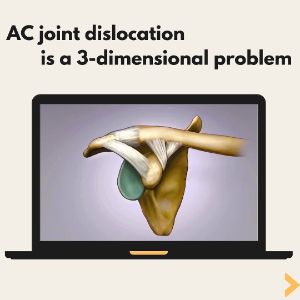
The coracoclavicular ligaments run from the underside of the collarbone down to the coracoid process of the shoulder blade, and they are the ones holding the collarbone down against the pull of gravity and muscle. They come in two parts.
- The Conoid Ligament: the inner of the two, cone shaped, resisting vertical displacement.
- The Trapezoid Ligament: the outer, broader ligament, resisting compression and rotation.
- Working Together: both must fail before the collarbone can displace significantly upward.
- Why It Matters: a reconstruction restores this connection, not the joint surface itself.
Both coracoclavicular ligaments must tear before the collarbone can rise meaningfully, and that single fact is what separates a grade 2 from a grade 3 in the grading system.
It also explains something patients find confusing. The patented reconstruction does not rebuild the acromioclavicular joint. It rebuilds the coracoclavicular connection beneath it, because that is what actually holds the collarbone in position. Restoring those ligaments restores the alignment of the joint above them, while reconstructing the acromioclavicular ligaments alone would not hold against the forces pulling the collarbone upward.
What the AC Joint Does
- Transfers Force: carries load between the arm and the trunk with every overhead motion.
- Allows Rotation: permits the collarbone to rotate as the arm elevates.
- Positions The Scapula: works with the shoulder blade to keep the socket oriented correctly.
- Small Range, Large Role: moves only a few degrees but influences the whole shoulder.
Like any joint with a cartilage surface, it can also become arthritic, either with age or years after an injury. AC joint arthritis produces pain localized precisely at the top of the shoulder, typically worse reaching across the body, and it is managed differently from arthritis of the main shoulder joint.
How the AC Joint Gets Injured
The mechanism is remarkably consistent, and understanding it precisely is what makes a reduction reliable during surgery.
Correct mechanism of injury
A force driving the point of the shoulder downward while the collarbone remains fixed is what tears the ligaments. The shoulder blade moves away from the collarbone rather than the collarbone moving upward, which is a distinction that sounds academic and is not.
Incorrect mechanism of injury
Patients and clinicians commonly picture the collarbone being driven upward, and that is not what happens. Reducing the joint by pushing the collarbone down works against the anatomy, while lifting the shoulder blade back up to meet the clavicle works with it.
Clinical Demonstration of the Mechanism of Injury
The video demonstrates the reduction in a live patient, showing the shoulder blade elevated to meet the collarbone rather than the collarbone pressed down.
Getting that direction right is not a technicality. It determines how the joint is reduced during surgery, and a surgeon working from the wrong mental model makes the repair harder than it needs to be. Dr. Struhl connects that mechanical understanding directly to how the repair is performed, explaining that “the problem with the older repairs was never the surgeon’s technique, it was the construct. A knot can slip and a knot can break.” – Steven Struhl, MD, Inventor, United States Patent 8,162,997
Schedule an AC Joint Evaluation in New York City
Understanding the anatomy is useful mostly as background, and what matters for a specific shoulder is which ligaments actually failed and how far the collarbone has moved. Dr. Struhl evaluates AC joint injuries at his Manhattan and White Plains offices and reviews outside imaging for patients traveling from elsewhere. Contact Us at (212) 207-1990 in New York City or (914) 328-4111 in Westchester.