If you’ve been told you have a Grade 3 AC joint separation, you probably want a straight answer: do you need surgery, or can it heal without it? The honest answer depends on the details of your injury. A Grade 3 AC separation sits in the middle zone between mild shoulder separations that often heal without surgery and more severe injuries that usually need surgical repair.
At Steven Struhl MD – AC Joint Separation, we see patients in New York City and Westchester with one main goal: helping you understand what your shoulder really needs.
What Is a Grade 3 AC Joint Separation?
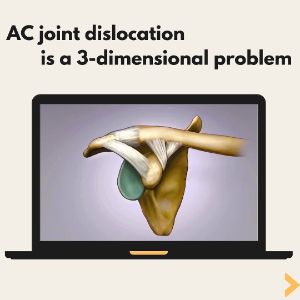
The AC joint is where your collarbone connects to the top of your shoulder blade. A Grade 3, or Type III, AC joint separation means the ligaments supporting this joint are torn, including the coracoclavicular ligaments that keep the collarbone in place.
Why Grade 3 Injuries Aren’t Always an Easy Call
Grade 3 AC separations can be tricky because treatment depends on more than the grade alone. Type I and II injuries often respond well to nonsurgical care. Type IV, V, and VI injuries usually need surgery. Type III injuries fall between those groups.
Current orthopedic research shows that treatment for Type III AC separations is still debated. Many cases start with nonsurgical care. Surgery may be considered if pain, instability, work needs, sports goals, or deformity make recovery more difficult.
Can a Grade 3 AC Separation Heal Without Surgery?
Yes, a true Grade 3 AC separation can sometimes heal well without surgery. Nonsurgical treatment might include using a sling, resting, managing pain, and doing physical therapy to restore shoulder movement and strength.
This approach may work if your pain gets better, your shoulder feels stable, and you can get back to daily activities without much weakness. Some people are fine with the visible bump, while others find it uncomfortable or annoying.
When Surgery May Be Recommended
Grade 3 AC joint separation surgery may be recommended when the shoulder doesn’t improve with conservative care or when the injury affects your ability to work, train, lift, or compete. Surgery may also be considered if you have ongoing pain, significant weakness, horizontal instability, or a deformity that causes functional problems.
Accurate diagnosis makes all the difference in this situation. Some injuries labeled Grade 3 may actually be more severe, including Grade 5 separations. Dr. Struhl’s approach includes careful evaluation of the joint, imaging, symptoms, and shoulder stability before discussing whether surgery makes sense.
Why Seeing an AC Joint Specialist Matters
AC joint injuries need more than a quick glance at an X-ray. You need a clear diagnosis, a realistic treatment plan, and a surgeon who understands the difference between an injury that may heal with rehab and one that may continue causing problems.
Dr. Steven Struhl is board-certified in Orthopedic Surgery and Sports Medicine/Arthroscopic Surgery. He focuses heavily on AC joint separation and has published research on AC joint reconstruction, including his Closed Loop Double Endobutton technique.
Talk With a Shoulder Specialist in New York or Westchester
If you’ve been told you have a Grade 3 AC separation, don’t guess your way through the next step. At Steven Struhl MD – AC Joint Separation, we’ll review your injury, symptoms, imaging, and goals so you understand your options. Contact our New York City or Westchester office to schedule an evaluation.
Posted on behalf of Steven Struhl MD