Grade 2 AC Joint Separation
A grade 2 separation is where this injury starts to become visible. The ligaments around the joint have torn completely, the ligaments below it have not, and the collarbone lifts slightly out of alignment as a result. There is often a small bump, and patients frequently notice it before they notice the pain has changed.
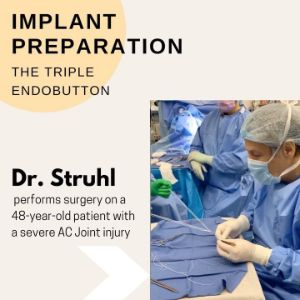
Steven Struhl, MD holds United States Patent 8,162,997 for AC joint reconstruction and has performed more than 200 of these procedures, though grade 2 injuries almost never require one. He is board certified in orthopedic surgery and separately in sports medicine.
What Happens in a Grade 2 Separation
- AC Ligaments: torn completely through, eliminating side to side joint stability.
- CC Ligaments: stretched or partially damaged but still holding the collarbone down.
- Displacement: partial elevation of the collarbone, typically less than its own width.
- Joint Stability: vertical stability preserved, horizontal stability reduced.
That combination is what produces the characteristic finding. The collarbone rises slightly because the AC ligaments no longer hold it in place, but it does not rise far, because the coracoclavicular ligaments below are still doing their job.
Grade 2 AC Separation Symptoms
- A Small Bump: a modest prominence at the top of the shoulder, subtler than a grade 3.
- Localized Pain: soreness concentrated at the joint, worse with overhead reaching.
- Pain Across The Body: discomfort bringing the arm toward the opposite shoulder.
- Reduced Strength: mild weakness pressing overhead during the acute phase.
Grade 2 AC Separation Treatment and Recovery
- Sling Support: one to two weeks of support during the most painful phase.
- Ice And Medication: managing inflammation through the first week or two.
- Physical Therapy: restoring motion first, then strengthening the surrounding musculature.
- Return To Activity: most patients resume full activity within six weeks to three months.
Grade 2 injuries are treated without surgery in nearly all cases. The small bump generally remains permanently, since the AC ligaments do not reattach to their original position, but it is a cosmetic finding rather than a functional one for most patients.
Dr. Struhl is direct that this grade rarely warrants an operation, noting that “not all cases require surgical intervention. It is our goal to establish tissue specific diagnosis early in the course of treatment.” – Steven Struhl, MD, Board Certified Orthopedic Surgeon
Frequently Asked Questions About Grade 2 AC Separations
- The acute pain generally settles within two weeks, but a full return to normal often takes six weeks to three months. Patients frequently feel fine at rest well before the shoulder tolerates overhead loading comfortably.
- Usually not entirely. The torn AC ligaments do not reattach in their original position, so a small step at the joint typically remains. For most patients it is a cosmetic finding rather than something that affects function.
- Rarely. Surgery is considered only when pain persists well beyond the expected recovery period, or when the joint remains unstable in the horizontal plane, which can happen and is worth checking if symptoms are not resolving.
- Yes, though pressing movements return last. Most patients resume general training within six to eight weeks and overhead pressing somewhat later, once the joint tolerates load without pain at the top of the shoulder.
Schedule an AC Joint Evaluation in New York City
A grade 2 that is still painful at three months is worth reexamining, because persistent symptoms at that point sometimes mean the injury was actually a grade 3 that a single film understated. Contact our practice at (212) 207-1990 in New York City or (914) 328-4111 in Westchester.
Medically reviewed by Steven Struhl, MD on