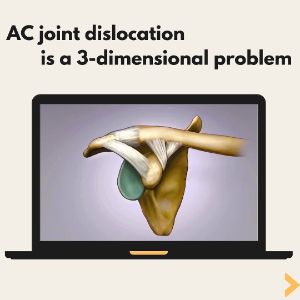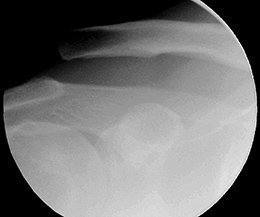
A grade 4 separation is the one most likely to be missed, and the reason is geometric. Every other high grade separation displaces the collarbone upward, where a standard X ray shows it plainly. A grade 4 displaces it backward, into or through the trapezius muscle, and a front to back film can look close to normal while the collarbone sits behind the acromion.
That makes the grading examination decisive rather than routine. Steven Struhl, MD has performed more than 200 acromioclavicular reconstructions, holds United States Patent 8,162,997 for the technique, and published his long term outcomes in The American Journal of Sports Medicine. He is board certified in orthopedic surgery and separately in sports medicine.
What Happens in a Grade 4 Separation
Both ligament systems have failed completely, as in a grade 3, but the collarbone travels in a different direction. It displaces posteriorly, piercing or tenting the trapezius muscle behind the joint, and in some cases the end of the bone can be felt through the muscle at the back of the shoulder.
- AC Ligaments: torn completely through.
- CC Ligaments: torn completely, eliminating vertical restraint.
- Displacement: posterior, backward into or through the trapezius muscle.
- Muscle Involvement: the trapezius is penetrated or tented by the displaced bone.
Why a Grade 4 Gets Missed
- Normal Looking Films: a standard front to back X ray can appear close to normal.
- No Obvious Bump: the collarbone goes backward rather than upward, so the contour looks less abnormal.
- Axillary View Required: the specific angle needed to see posterior displacement is not always taken.
- Recorded As Lower Grade: the injury is frequently documented as a grade 2 or 3 as a result.
The practical consequence is significant. A grade 4 requires surgical reconstruction, so an injury recorded as a grade 2 is sent home in a sling and returns months later as a chronic case, which is more involved to repair and slower to heal.
Dr. Struhl treats the missing view as the whole problem, noting that “by using high quality imaging modalities such as MRI early in the treatment process, we get to the heart of the problem quickly and precisely.” – Steven Struhl, MD, Board Certified Orthopedic and Sports Medicine Surgeon
Grade 4 AC Separation Treatment
Grade 4 separations require surgical reconstruction. Non surgical treatment does not restore the collarbone to position, and the posterior displacement through the trapezius does not resolve with time or therapy.
- Accurate Imaging: axillary views, and CT when the pattern remains unclear.
- Surgical Reconstruction: the coracoclavicular ligaments are rebuilt to restore alignment.
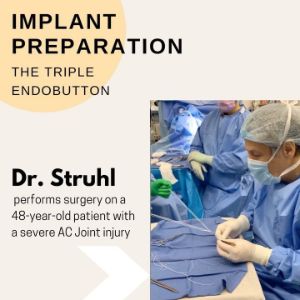
- The Patented Technique: a continuous knotless loop between two titanium buttons, placed through one small incision.
- Structured Rehabilitation: sling protection, then motion, then strengthening over four to six months.
Frequently Asked Questions About Grade 4 AC Separations
- Yes, in practical terms. The collarbone has displaced backward through the trapezius and both ligament systems have failed, and neither the position nor the stability is restored by immobilization or therapy.
- It requires an axillary view, an X ray taken from a specific angle that shows the collarbone’s position front to back. A standard shoulder series can appear nearly normal, which is why examination findings that suggest instability warrant the additional view.
- It remains repairable. Chronic reconstruction is more involved than acute repair and heals more slowly, but in Dr. Struhl’s published outcomes study most patients had chronic rather than acute injuries and their results were comparable to the acute group.
- A sling protects the repair for roughly six weeks, motion work follows through about three months, and most patients reach unrestricted activity between four and six months, depending on the demands they place on the shoulder.
Schedule an AC Joint Evaluation in New York City
If your shoulder was imaged with a single standard X ray and you can feel a prominence at the back of the shoulder rather than the top, the grade is worth confirming, because a grade 4 read as a grade 2 is the most consequential misread in this injury. Contact our practice at (212) 207-1990 in New York City or (914) 328-4111 in Westchester.
Contact our practice today to schedule a consultation with Dr. Struhl.