Grade 5 AC Joint Separation
A grade 5 separation is the severe end of the upward displacement pattern. The collarbone rides dramatically higher than normal, the muscle attachments across the top of the shoulder have been stripped away from the bone, and there is rarely any diagnostic uncertainty. Patients and clinicians both know something significant has happened.
These are the reconstructions Steven Struhl, MD designed his technique for. He holds United States Patent 8,162,997 for the continuous loop double button construct, has performed more than 200 of these procedures, and reported outcomes in The American Journal of Sports Medicine with a mean follow up over five years. He is board certified in orthopedic surgery and separately in sports medicine.
What Happens in a Grade 5 Separation
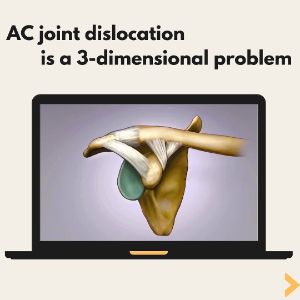
A grade 5 is a grade 3 taken considerably further. Both ligament systems are torn, and in addition the deltotrapezial fascia, the sheet of tissue connecting the deltoid and trapezius muscles across the top of the shoulder, is stripped off the collarbone. Without that attachment the bone rises far higher than in a grade 3, commonly to well over twice the normal separation.
- AC Ligaments: torn completely through.
- CC Ligaments: torn completely, with no vertical restraint remaining.
- Deltotrapezial Fascia: stripped from the collarbone, allowing severe elevation.
- Displacement: upward, typically exceeding one hundred percent of normal.
Grade 5 AC Separation Symptoms
- A Pronounced Bump: obvious deformity at the top of the shoulder, visible through clothing.
- Severe Acute Pain: significant pain that makes most arm movement difficult initially.
- A Sagging Shoulder: the whole shoulder appears dropped relative to the elevated collarbone.
- Functional Loss: marked difficulty lifting, reaching overhead, or bearing weight through the arm.
Grade 5 AC Separation Surgery
Grade 5 injuries are reconstructed. The degree of displacement and the loss of the fascial attachment mean the joint does not return to position on its own, and non surgical treatment leaves a permanently prominent bump alongside meaningful functional loss.
- Reconstruction: the coracoclavicular ligaments are rebuilt to restore normal alignment.
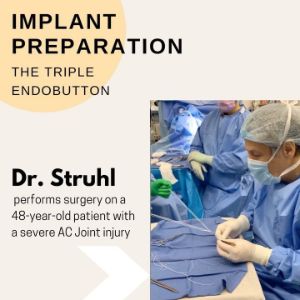
- The Patented Construct: two titanium buttons joined by a continuous knotless loop set to fixed length.
- Fascial Repair: the stripped deltotrapezial tissue is repaired as part of the procedure.
- Recovery: sling protection for roughly six weeks, with unrestricted activity at four to six months.
Dr. Struhl designed the construct around the failure mode that troubled him most in severe cases, explaining that “the problem with the older repairs was never the surgeon’s technique, it was the construct. A knot can slip and a knot can break.” – Steven Struhl, MD, Inventor, United States Patent 8,162,997
Frequently Asked Questions About Grade 5 AC Separations
- Effectively yes. The displacement is severe, the fascial attachments across the top of the shoulder have been stripped, and neither position nor function is restored without reconstruction. Non surgical treatment leaves a permanent deformity and lasting weakness.
- Both tear the same two ligament systems, but a grade 5 also strips the deltotrapezial fascia from the collarbone, which removes the last restraint and allows the bone to rise far higher. Displacement typically exceeds one hundred percent of normal.
- Yes. Chronic reconstruction is more involved than acute repair, but in the published outcomes study twenty six of thirty five patients had chronic injuries and their results were comparable to the acute group.
- A sling protects the reconstruction for roughly six weeks, supervised motion follows through about three months, and most patients return to unrestricted activity between four and six months depending on their demands.
Schedule an AC Joint Evaluation in New York City
A grade 5 separation is the injury this practice was built around, and it is worth evaluating whether it happened last week or three years ago. Dr. Struhl reviews outside imaging for patients traveling from outside the region. Contact our practice at (212) 207-1990 in New York City or (914) 328-4111 in Westchester.