AC Joint Separation Recovery Time
Recovery from an AC joint separation depends almost entirely on two things, which grade the injury is and whether it was repaired surgically. A grade 1 sprain can settle in two weeks. A reconstructed grade 5 takes months. Most of the frustration patients describe comes from being given one timeline when their injury belonged to the other.
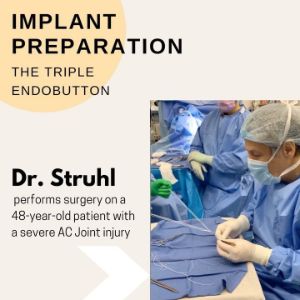
Steven Struhl, MD has performed more than 200 acromioclavicular reconstructions and holds United States Patent 8,162,997 for the technique, so the recovery described below reflects what his own patients actually experience rather than a general reference range. He is board certified in orthopedic surgery and separately in sports medicine and has practiced in New York since 1991.
Recovery Time Without Surgery
Grades 1 and 2 are treated without surgery in nearly all cases, and many grade 3 injuries are managed this way as well.
- Days One To Seven: sling support, ice, and pain control while the acute inflammation settles.
- Weeks One To Two: gentle motion begins, and grade 1 injuries are often comfortable by this point.
- Weeks Two To Six: progressive range of motion and early strengthening for grade 2 injuries.
- Weeks Six To Twelve: return to full activity, with contact sport generally the last thing restored.
Grade 1 injuries commonly resolve within two to three weeks. Grade 2 injuries more often take six weeks to three months to feel fully normal, and a persistent ache at the top of the shoulder past that point is worth reevaluating rather than waiting out.
Recovery Time After AC Joint Surgery
Surgical recovery is longer, and it is structured around protecting the reconstruction while biologic healing takes hold. The construct itself is stable immediately, but the ligaments and scar tissue that ultimately hold the repair need time to form.
- Weeks One To Six: a sling protects the reconstruction, with gentle pendulum motion permitted.
- Weeks Six To Twelve: the sling is discontinued and supervised range of motion work begins.
- Months Three To Four: progressive strengthening of the shoulder and scapular musculature.
- Months Four To Six: return to unrestricted activity, including overhead lifting and contact sport.
Most patients are driving by around six weeks, back to desk work considerably sooner, and back to the gym in a limited way by around three months. Full confidence in the shoulder tends to arrive later than full clearance.
Dr. Struhl treats the timeline as something to set honestly at the start, noting that “the things you love to do aren’t just the causes of your injury: they’re the things you want to get back to. Together, we can map out a program of treatment that will put you back in the action.” – Steven Struhl, MD, Board Certified Orthopedic and Sports Medicine Surgeon
What Changes Your Recovery Time
- Injury Grade: the single largest factor, with each grade adding meaningfully to the timeline.
- Time Since Injury: chronic reconstructions can heal more slowly than acute repairs.
- Physical Therapy: consistent supervised therapy shortens recovery more than any other variable.
- Activity Demands: a desk worker returns sooner than a lineman or a competitive cyclist.
Physical therapy deserves emphasis. It is the part of recovery patients control, and it is the most common reason two people with identical injuries finish months apart. The practice offers on site physical therapy so the rehabilitation happens alongside the surgical follow up rather than in a separate system.
Related Recovery Timelines
- AC Joint Sprain Recovery Time: what to expect from mild grade 1 and grade 2 injuries.
- Shoulder Separation Recovery Time: general recovery expectations after a separated shoulder.
Frequently Asked Questions About AC Joint Recovery
- It depends on the grade. A grade 1 sprain commonly settles within two to three weeks, a grade 2 takes six weeks to three months, and a surgically reconstructed grade 3 through 5 injury generally reaches unrestricted activity between four and six months after the procedure.
- Most patients resume driving around six weeks, once the sling is discontinued and the arm can control the wheel safely. Driving earlier while still sling dependent is neither safe nor advisable, regardless of how comfortable the shoulder feels at rest.
- Lower body work is usually permitted early. Upper body work returns gradually from around three months, and overhead pressing is the last movement restored, generally between four and six months, because it loads the reconstruction most directly.
- Some aching through the recovery period is normal as tissue remodels. Aching that is not improving month over month, particularly with a persistent bump or weakness overhead, can mean the original grade was underestimated or a repair has lost position, and it deserves reevaluation rather than patience.
- In non surgical treatment, generally not. The prominence from a grade 3 or higher separation is caused by the collarbone sitting higher than normal, and without reconstruction it typically remains permanently even after the pain resolves.
- Consistent physical therapy is the one factor within a patient’s control that reliably shortens the timeline. Skipping the protective early phase does the opposite, since a reconstruction loaded too soon can lose position, and regaining that is far harder than waiting.
Schedule an AC Joint Evaluation in New York City
Recovery goes wrong most often when the original grade was wrong, because a patient given a two week timeline for what was actually a grade 3 spends months wondering why they are behind. Dr. Struhl evaluates AC joint injuries at his Manhattan and White Plains offices and reviews outside imaging for patients traveling from elsewhere. Contact the orthopedic clinic of Dr. Steven Struhl at (212) 207-1990 in New York City or (914) 328-4111 in Westchester.