Timing of AC Joint Separation Surgery
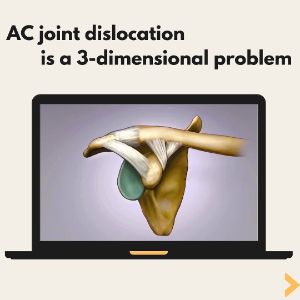
There is a window after an AC joint separation during which the repair is a fundamentally different operation. Within roughly the first three to six weeks, the torn ligaments can still be brought back into position and given the chance to heal to their own attachments. After that window they retract and scar, and restoring the joint requires reconstructing what was lost rather than repairing what tore.
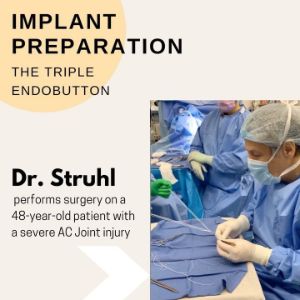
Both operations work. One is simpler. Steven Struhl, MD has performed more than 200 acromioclavicular reconstructions across the full range of acute and chronic injuries and published outcomes for both groups, so this is a distinction he can speak to from his own data rather than from general principle. He is board certified in orthopedic surgery and separately in sports medicine.
Acute Repair Versus Chronic Reconstruction
- Acute Repair: performed within roughly three to six weeks, while native ligaments can still heal.
- Chronic Reconstruction: performed later, requiring biologic augmentation to replace lost tissue.
- The Difference: acute repair restores what tore, chronic reconstruction rebuilds what is gone.
- Both Are Effective: published outcomes for chronic cases were comparable to acute ones.
The distinction is real and it is also frequently overstated. A patient told they missed their window and nothing can be done now has been given wrong information. Twenty six of the thirty five patients in Dr. Struhl’s published study had chronic dislocations, and their results matched the acute group.
Why the Early Window Matters
Immediately after a complete separation, the torn coracoclavicular ligaments are still present, still attached at one end, and still capable of healing if the clavicle is returned to position and held there. That is the biological basis for early repair.
- Native Tissue Heals: the patient’s own ligaments reattach rather than being replaced.
- Less Mobilization Required: retracted and scarred tissue does not need to be freed.
- A More Direct Operation: the procedure is generally shorter and less involved.
- Predictable Reduction: restoring anatomic position is easier before scar tissue sets.
What Changes After the Window Closes
Ligaments that have retracted and scarred cannot simply be pulled back and expected to heal. Reconstruction then relies on the patented construct to hold position while biologic augmentation, typically coracoacromial ligament transfer, creates a new stabilizing structure over the following months.
- Tissue Mobilization: scarred tissue planes must be freed before reduction is possible.
- Biologic Augmentation: ligament transfer supplies what the original ligaments no longer can.
- A Longer Procedure: more surgical steps, though still performed through a small incision.
- Comparable Results: published outcomes in chronic patients matched the acute group.
Dr. Struhl treats the delay as a reason to evaluate sooner rather than a reason to give up later, noting that “it is our goal to establish tissue specific diagnosis early in the course of treatment, avoiding the weeks of therapy and repetitive injections that are typically given as initial treatment for orthopedic issues.” – Steven Struhl, MD, Board Certified Orthopedic and Sports Medicine Surgeon
Who Should Move Quickly
- Grade 4, 5, or 6 Injuries: displacement severe enough that reconstruction is essentially certain.
- Competitive And Overhead Athletes: demands the unstable joint will not meet, with a season at stake.
- Manual And Overhead Workers: occupations that load the shoulder daily.
- Clear Instability: a joint demonstrating significant movement on examination early.
For these patients the decision is usually not whether but when, and moving inside the early window means a simpler operation. For a grade 3 in a lower demand patient, a period of conservative treatment first is entirely reasonable, and the option of later reconstruction remains open.
Frequently Asked Questions About AC Joint Surgery Timing
- For patients who clearly need reconstruction, roughly three to six weeks is the window in which an acute repair remains possible. That does not mean deciding within days, but it does mean being evaluated promptly rather than waiting to see whether the shoulder settles.
- No. Chronic reconstruction is more involved than acute repair but it is highly effective, and most patients in Dr. Struhl’s published outcomes study were chronic cases whose results matched the acute group. Anyone told nothing can be done has been misinformed.
- That is a reasonable choice for many grade 3 injuries, and it does not close the surgical door. The tradeoff is that if reconstruction is eventually needed it will be a chronic repair rather than an acute one, which is worth understanding before deciding rather than afterward.
- Not substantially. The rehabilitation timeline after chronic reconstruction is broadly similar to acute repair, roughly six weeks of sling protection followed by progressive motion and strengthening. Full recovery detail is here.
- Because for grade 3 injuries the evidence genuinely supports both approaches, and the right answer depends on the true grade, whether horizontal instability is present, and what the patient needs the shoulder to do. Grades 4 and above are far less debated.
- The ligament damage does not progress on its own without a new injury. What changes is the surgical option available, since the window for acute repair closes as the tissue retracts and scars.
Schedule an AC Joint Evaluation in New York City
If your injury happened in the last few weeks and the grade suggests reconstruction is likely, an evaluation now rather than in a month meaningfully changes which operation is available to you. If it happened years ago, it is still worth evaluating. Dr. Struhl sees patients at his Manhattan and White Plains offices and reviews outside imaging for patients traveling from farther away. Contact our practice at (212) 207-1990 in New York City or (914) 328-4111 in Westchester.