Grade 3 AC Joint Separation
A grade 3 separation is a true dislocation of the acromioclavicular joint. Both ligament systems have torn completely, the collarbone has lost its anchor to the shoulder blade, and the bump that results is the one most people picture when they hear the phrase separated shoulder.
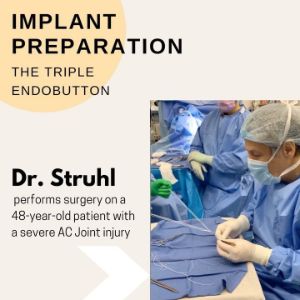
It is also the only grade where reasonable surgeons disagree, which is why patients with this injury so often collect contradictory advice. Steven Struhl, MD has performed more than 200 acromioclavicular reconstructions, holds United States Patent 8,162,997 for the technique, and published his long term outcomes in The American Journal of Sports Medicine, so his view on this grade comes from following his own patients for years rather than from a textbook range. He is board certified in orthopedic surgery and separately in sports medicine.
Do I Have a Grade 3 AC Joint Separation?
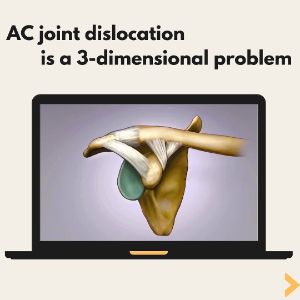
The finding that defines a grade 3 is complete rupture of the coracoclavicular ligaments, the pair running from the underside of the collarbone down to the coracoid process of the shoulder blade. Once those fail, nothing holds the collarbone down, and it rides upward relative to the shoulder blade.
- A Visible Bump: obvious prominence at the top of the shoulder, more pronounced than a grade 2.
- Complete Ligament Failure: both the AC and the coracoclavicular ligaments are torn through.
- Measurable Displacement: the coracoclavicular distance increases by roughly 25 to 100 percent.
- Joint Instability: the collarbone moves under examination in ways a stable joint does not.
How a Grade 3 Is Confirmed
This is where grade 3 injuries are most often gotten wrong, and the error runs in one direction. A standard shoulder film taken with the arm supported allows the joint to sit closer to normal than it does under load, so a grade 3 is regularly recorded as a grade 2.
- Comparison Imaging: both shoulders on one film, measured against your own uninjured side.
- Digital Measurement: the coracoclavicular distance measured precisely rather than estimated by eye.
- Horizontal Stability Testing: assessing front to back movement, not only vertical displacement.
- Stress Or Weighted Views: imaging under load when the resting film and the examination disagree.
Horizontal stability deserves particular attention. A grade 3 that is stable front to back behaves very differently from one that is not, and that distinction influences the surgical decision more than the vertical measurement alone.
Dr. Struhl treats the measurement as something to establish properly rather than approximately, noting that “by using high quality imaging modalities such as MRI early in the treatment process, we get to the heart of the problem quickly and precisely.” – Steven Struhl, MD, Board Certified Orthopedic and Sports Medicine Surgeon
Initial Treatment for a Grade 3 Separation
Most grade 3 injuries begin with non surgical management, and a meaningful number never need anything more.
- Sling Support: two to four weeks of protection through the acute painful phase.
- Ice And Medication: managing inflammation and pain in the early weeks.
- Progressive Motion: range of motion work introduced as comfort allows.
- Strengthening: rebuilding the scapular and shoulder musculature that compensates for the joint.
What conservative treatment does not do is restore the collarbone to position. The bump remains, because the torn ligaments do not reattach where they were. For many patients that is entirely acceptable. For others it is not, and that is the decision.
When Grade 3 Surgery Enters the Conversation
- Persistent Symptoms: pain or weakness continuing well past the expected recovery window.
- Horizontal Instability: front to back movement that conservative treatment does not settle.
- High Demand Shoulders: overhead athletes and manual workers whose demands the joint cannot meet.
- Deformity Concerns: a prominence the patient finds unacceptable, which is a legitimate reason.
The full case for and against operating is covered on the dedicated page, grade 3 AC separation, should you or should you not have surgery.
Frequently Asked Questions About Grade 3 AC Separations
- It is a complete dislocation of the joint, so structurally yes. Functionally many patients do well without surgery, which is what makes this grade genuinely debated. Serious and requiring surgery are not the same thing here.
- No. The prominence comes from the collarbone sitting higher than normal after the coracoclavicular ligaments tore, and without reconstruction it is permanent. Pain typically resolves, and the bump typically does not.
- In a grade 2 the coracoclavicular ligaments are intact, which keeps the collarbone mostly in position. In a grade 3 they are torn completely, which is what allows the visible displacement and produces genuine instability.
- Regularly, and it is the most common grading error in this injury. A single standard X ray taken with the arm supported can understate the displacement, so comparison views and a hands on stability examination matter more than one image.
- Most patients regain comfortable function over roughly six to twelve weeks, with strength continuing to improve afterward. Full recovery timelines are here, including what to expect if reconstruction is performed.
- Yes. Chronic reconstruction is more involved than acute repair, but twenty six of the thirty five patients in Dr. Struhl’s published outcomes study had chronic injuries and their results were comparable to the acute group.
Schedule a Grade 3 Evaluation in New York City
If you were told you have a grade 3 and given conflicting advice about what to do next, that is not unusual, and the first useful step is confirming the grade was measured properly rather than estimated from one film. Dr. Struhl evaluates AC joint injuries at his Manhattan and White Plains offices and reviews outside imaging for patients traveling from farther away. Contact our practice at (212) 207-1990 in New York City or (914) 328-4111 in Westchester.